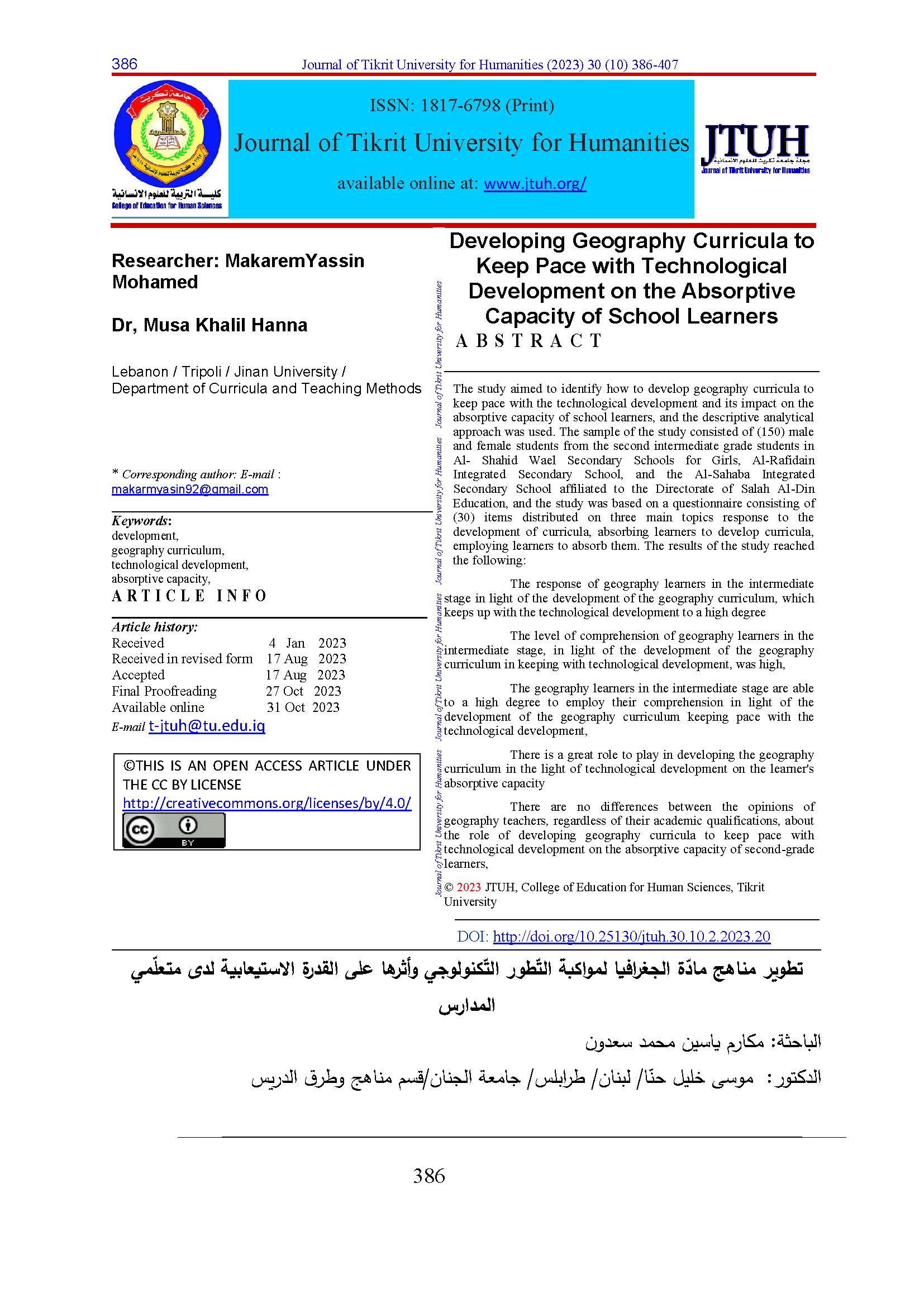
Developing Geography Curricula to Keep Pace with Technological Development on the Absorptive Capacity of School Learners
Article Sidebar
Main Article Content
Abstract
The study aimed to identify how to develop geography curricula to keep pace with the technological development and its impact on the absorptive capacity of school learners, and the descriptive analytical approach was used. The sample of the study consisted of (150) male and female students from the second intermediate grade students in Al- Shahid Wael Secondary Schools for Girls, Al-Rafidain Integrated Secondary School, and the Al-Sahaba Integrated Secondary School affiliated to the Directorate of Salah Al-Din Education, and the study was based on a questionnaire consisting of (30) items distributed on three main topics response to the development of curricula, absorbing learners to develop curricula, employing learners to absorb them. The results of the study reached the following:
The response of geography learners in the intermediate stage in light of the development of the geography curriculum, which keeps up with the technological development to a high degree
The level of comprehension of geography learners in the intermediate stage, in light of the development of the geography curriculum in keeping with technological development, was high,
The geography learners in the intermediate stage are able to a high degree to employ their comprehension in light of the development of the geography curriculum keeping pace with the technological development,
There is a great role to play in developing the geography curriculum in the light of technological development on the learner's absorptive capacity
There are no differences between the opinions of geography teachers, regardless of their academic qualifications, about the role of developing geography curricula to keep pace with technological development on the absorptive capacity of second-grade learners,
Metrics
Article Details

This work is licensed under a Creative Commons Attribution 4.0 International License.




References
Al-Asbahi, Heba. (2018). The impact of the use of technology on modern teaching methods, Journal of the Faculty of Education, Assiut University, Egypt, (34): 336-364.
Al-Bashir, Al-BaqirRahma. (2017). Geography teacher training guide for the third grade, the basic education stage, General Administration for Educational Training and Qualification, Ministry of Education, Sudan.
Al-Jubouri, Eman Abdel-Karim., Abdel-Ani, Omar Majeed. &Askari, KifahYahyaSalih. (2016). Curriculum and textbook, reference series on curricula and teaching methods for the humanities and sciences.
Hamri, Muhammad. (2022). The effectiveness of using the interactive whiteboard in acquiring geographic concepts among common core art students, Moasher Journal for Exploratory Studies, 2 (5): 403-423.
Abd al-Hay, Ikhlas Muhammad. (2016). Partners in our journey. Amman, Jordan: Dar Al Masirah for publication and distribution.
Saeed, BakhtiarHabib. (2021). The use of educational means and techniques in teaching geography in the preparatory stage in the district of Kalar, its obstacles, and teachers' attitudes towards it, 6 (1): 152-176.
Odeh, Salih Hamid. (2015). The degree of possessing geography teachers in the intermediate stage in Iraq of tourist awareness, an unpublished master's thesis, College of Educational Sciences, Al al-Bayt University.
Al-Fadl, Muhammad Al-Rifai. (2014). The pros and cons of the multiplicity of contemporary digital technologies in illustrative design and its printing, an unpublished PhD thesis, Faculty
Najadat, Ashraf Mahmoud. (2021). Perceptions of geography teachers in secondary schools about the effectiveness of distance learning, Journal of Human and Natural Sciences, 2 (10). Postgraduate studies, Sudan University of Science and Technology.Demirci, A., Karaburun, A., &Kılar, H. (2013). Using Google Earth as an educational tool in secondary school geography lessons. International Research in Geographical and Environmental Education, 22(4), 277-290.
Harani, S. (2015). A study of the extent to which ict is being implemented in the teaching and learning of advanced level geography in Empandeni cluster schools.
Huang, F., Rice, J., & Martin, N. (2015). Does open innovation apply to China? Exploring the contingent role of external knowledge sources and internal absorptive capacity in Chinese large firms and SMEs. Journal of Management & Organization, 21(5), 594-613.
Lau, A. K., & Lo, W. (2015). Regional innovation system, absorptive capacity and innovation performance: An empirical study. Technological Forecasting and Social Change, 92, 99-114.
Musumba, M. A. (2019). Integration Of Information Communication Technology (ICT) In the instruction of geography in secondary schools in Matungu, Kakamega-Kenya (Doctoral dissertation, Moi University).