الفلسفة التربوية لنظام حقوق الطفل في التربية والتعليم
الشريط الجانبي للمقالة
محتوى المقالة الرئيسي
الملخص
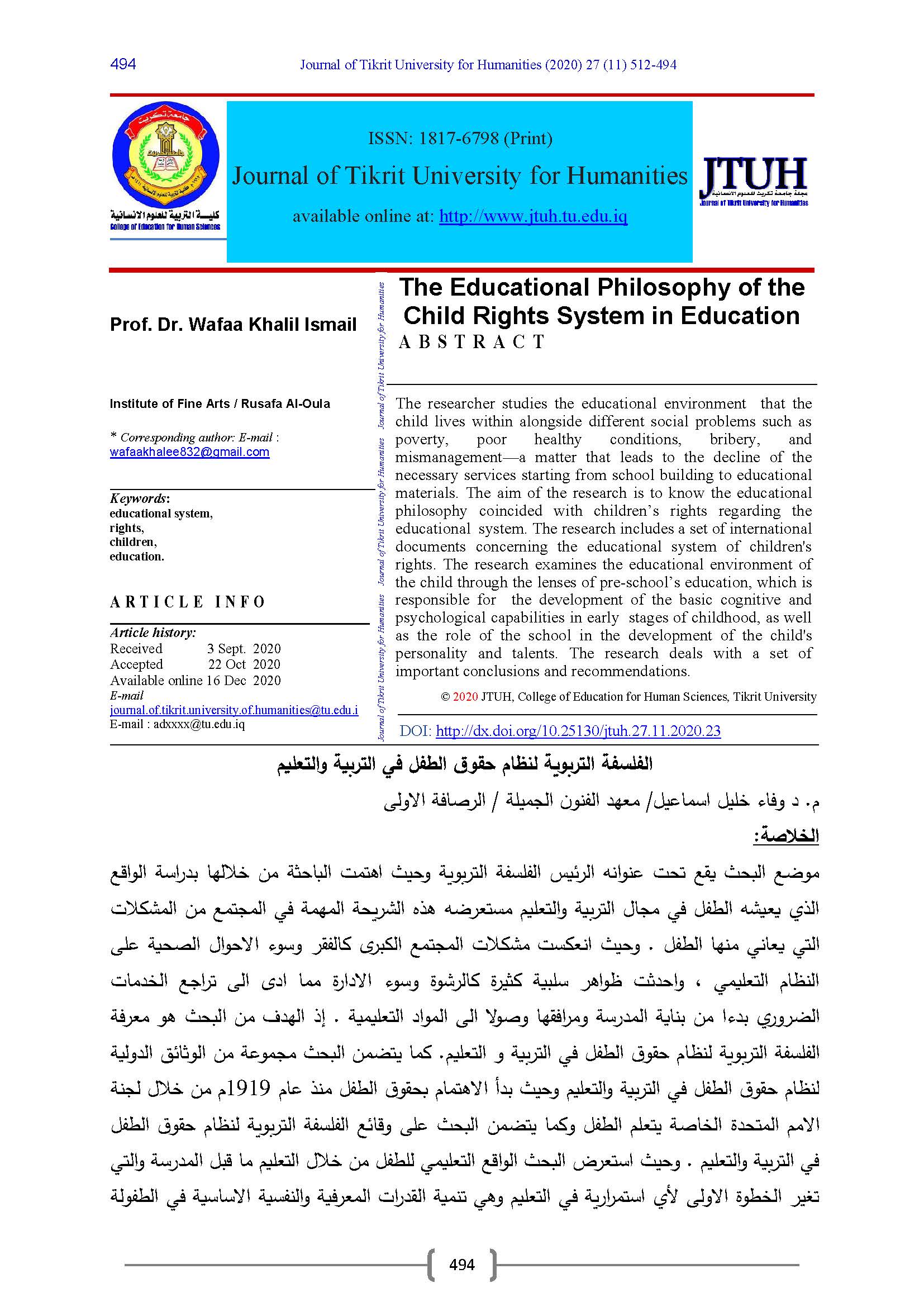
موضع البحث يقع تحت عنوانه الرئيس الفلسفة التربوية وحيث اهتمت الباحثة من خلالها بدراسة الواقع الذي يعيشه الطفل في مجال التربية والتعليم مستعرضه هذه الشريحة المهمة في المجتمع من المشكلات التي يعاني منها الطفل . وحيث انعكست مشكلات المجتمع الكبرى كالفقر وسوء الاحوال الصحية على النظام التعليمي ، واحدثت ظواهر سلبية كثيرة كالرشوة وسوء الادارة مما ادى الى تراجع الخدمات الضروري بدءا من بناية المدرسة ومرافقها وصولا الى المواد التعليمية . إذ الهدف من البحث هو معرفة الفلسفة التربوية لنظام حقوق الطفل في التربية و التعليم. كما يتضمن البحث مجموعة من الوثائق الدولية لنظام حقوق الطفل في التربية والتعليم وحيث بدأ الاهتمام بحقوق الطفل منذ عام 1919م من خلال لجنة الامم المتحدة الخاصة يتعلم الطفل وكما يتضمن البحث على وقائع الفلسفة التربوية لنظام حقوق الطفل في التربية والتعليم . وحيث استعرض البحث الواقع التعليمي للطفل من خلال التعليم ما قبل المدرسة والتي تغير الخطوة الاولى لأي استمرارية في التعليم وهي تنمية القدرات المعرفية والنفسية الاساسية في الطفولة المبكرة وأيضا دور المدرسة في نمو شخصية الطفل ومواهبه وايضا يتضمن البحث على التعليم والتربية وحق الطفل ، فبالنسبة للتعليم حيث يعد احد المؤشرات المهمة في الميادين الاساسية في قياس مستوى التنمية البشرية ومستوى المعيشة لأي مجتمع اما التربية وحقوق الطفل وهو حديث الشأن العام والتنمية وتحديث المجتمع وذلك لان التطلع الى التنمية والتحديث لا يستقيم من دون استحضار الحق قي التعليم وحرية الرأي ، وأيضا يتناول البحث مجموعة من الاستنتاجات والمقترحات المهمة للبحث .
المقاييس
تفاصيل المقالة

هذا العمل مرخص بموجب Creative Commons Attribution 4.0 International License.




المراجع
Ibn Sina, Al-Hussein Bin Ali, Al-Qanun in Medicine, Dar Sader, Beirut, Three Volumes, DDT, 1963, pp. 26-30.
Abu, Hassan, Human Rights Education, research published on the Internet, 2006, p. 61.
Ihssan Hassan Muhammad, Studies in educational thought, Dar Al-Shorouk, Jeddah, Saudi Arabia, 1st Edition, 1983, p.50.
Al-Irashi, Muhammad Attiyah, Islamic Education and its Philosophers, Dar Al-Fikr Al-Arabi, Cairo, Edition 3, 1961 p. 26.
Baabad, Ali Hood, Education systems and their philosophies in the countries of the world, Sana'a University Press, Yemen, 1984, p.75.
Joeli, Saeed Salem, The Concept of Child Rights and Protection in Islamic Law and Public International Law, Research presented to the Symposium of the Association of Islamic Universities in Riyadh, Saudi Arabia, 2000, p. 4.
Human Rights for Children, A Simplified Text of the Universal Declaration of Human Rights, The Arab Institute for Human Rights, the Tunisian Branch of Amnesty International, 1995, pp. 1000-107.
Al-Dakhil, Abdul Aziz Abdullah, Dictionary of Social Service and Social Sciences Terms, Dar Al-Manahij for Publishing and Distribution, Edition 1, 2006, p. 46.
Ramadan Amara, Teacher’s Guide to Human Rights Education, Arab Institute for Human Rights, 2001, pp. 13-25.
Rashid, Ali Hussein, Education and Teaching of Human Rights, Al Wasat Al Thaqafia Press, Morocco, 2006, p. 18.
Al-Razi, Muhammad Ibn Abi Bakr, Mukhtar Al-Sahih, Dar Al-Fikr for Printing and Publishing, Beirut, 1973, pp. 146-147.
Zaki, Ahmad, Dictionary of Social Sciences Terms, Lebanon Library, Beirut, 1977, 347.
Al-Sebaei, Abdul Aziz and Abdullah Turki, From Contemporary Education Issues, Ali Bin Ali Press, Qatar, Doha, 1982, p. 30.
Abdel-Daem, Abdullah Towards an Arab Educational Philosophy, Educational Philosophy and the Future of the Arab Nation, Center for Arab Unity Studies, Beirut, 1st Edition, 1991, p. 74.
Ali, Saeed Ismail, Contemporary Educational Philosophies, The World of Knowledge Series, The National Council for Culture, Arts and Literature, Kuwait, Issue 198, 1995, p.19.
Abdullah, Ahmed Human Rights - Participation Rights and the Duty of Dialogue, Cairo Institute for Human Rights Studies, Cairo, 2005, pp. 180-189.
Ammar, Hamed, Arab education and its developmental return, Arab Future Magazine, Issue 3, 1978, pp. 9-15.
Al-Adayleh, Amin, A look at the rights of the child, a legal point of view, Raya Mu'ta Magazine, Volume 4, Jordan, Issue 16, 1999, pp. 26 -55.
Al-Ani, Abd al-Latif, Human Rights in Islam, a comparative study, a research published in the Journal of the College of Arts, Issue 75, 2006, p 194.
Abdel-Majid, Layla, Communication and Media Policies and their Impact on Culture and Education, Aalem Al-Thought, Vol. 23, Issues 1, 2, 1992, pp. 58-59.
Al-Ghazali, Abu Hamed, Revival Science Religion, Dar Al-Shaab Press, Cairo, c. 1984, p. 55.
Madi, Ali, Philosophy of Education and Freedom, Dar Al Masirah, Beirut, 2nd Edition, 1979, p. 40.
Madkour, Ibrahim and others, Dictionary of Social Sciences, House of General Cultural Affairs, Cairo, Issue 3, 1994, p. 69.
The United Nations Children's Fund (UNICEF) in cooperation with the Information and Decision Union Support Center, Center in Hasid Egypt for Situation Analysis, 1948, pp. 25-40.
Nafaa, Hussein Al-Sayed, The Arab League and Human Rights, Arab Affairs, No. 13, 1982, p. 97.
Al-Naklawi, Ahmad Muhammad Mansour, the educational situation in the Arab Gulf states in the light of the Universal Declaration of the Rights of the Child, Arab Education Library for the Gulf States Press, An Analytical Evaluation Study, Riyadh, 1986, p. 121.
Al-Hiti, Hadi Numan, Children's Culture, The World of Knowledge, a monthly cultural book series issued by the National Council for Culture, Title and Literature, Kuwait, 1988, pp. 15-50.
Ministry of Planning and Development Cooperation, Central Organization for Statistics and Information Technology, United Nations Development Program, Map of Deprivation and Living Standards in Iraq, 2006, p. 34.
Wahhab, Hassan, The Reference Guide for the Culture of Human Rights, New Knowledge Press, Riyadh, Morocco, 1969, pp. 15-16.
Williams, J, R, Inclusion guide for Arabic speakers, translated by: Fouad Abu Zahra, Center for Digital Education Studies, Morocco, 2003, p. 61.
The Qatari Ministry of Education, School Life Guide, Doha, 2006, p. 24.