أثر استراتيجية التعلم المتقن على تحصيل طلبة المدارس الإعدادية دارسي اللغة الانكليزية لغة- أجنبية في النصوص الأدبية
الشريط الجانبي للمقالة
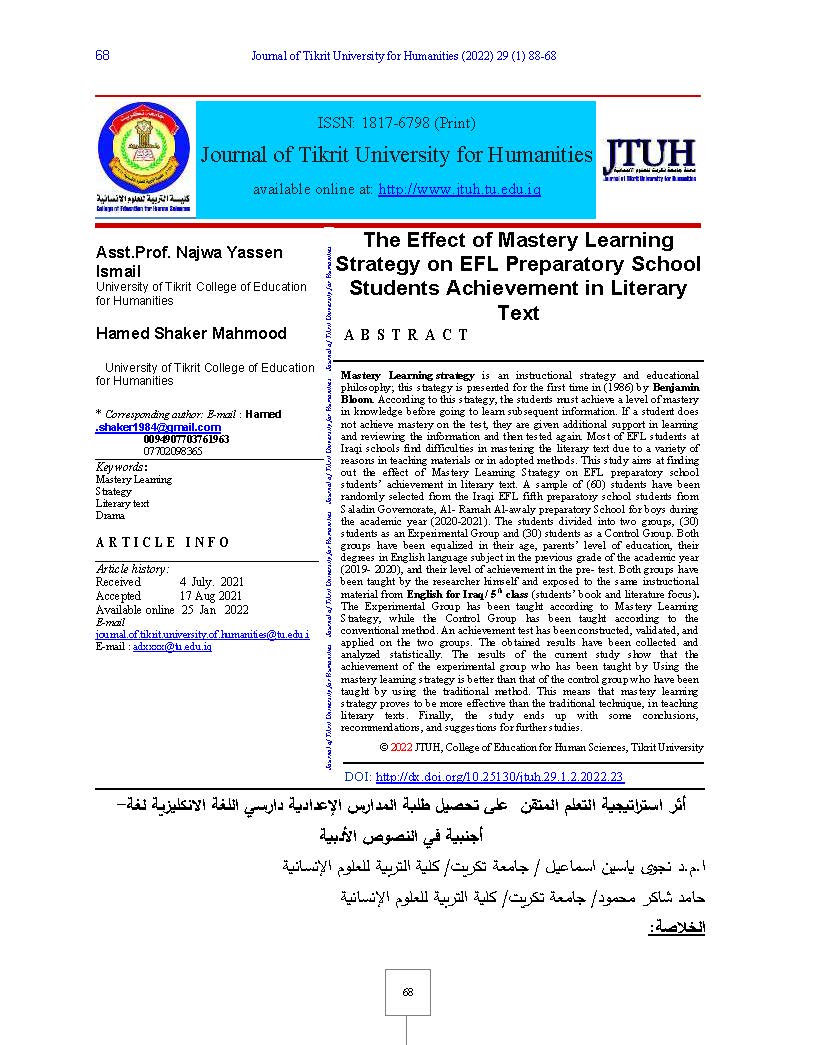
محتوى المقالة الرئيسي
الملخص
إن استراتيجية التعلم المتقن هي استراتيجية تعليمية وفلسفية ، وهذه الاستراتيجية قدمها بنيامين بلوم لأول مرة في عام (1986). وفقا لهذه الاستراتيجية ، يجب أن يحقق الطلاب مستوى من الإتقان في المعرفة قبل أن يتعلموا المعلومات اللاحقة. وفي حالة عدم إتقان الطالب للاختبار ، يقدم له دعم إضافي في تعلم المعلومات ومراجعتها ثم يختبر مرة أخرى. ويجد معظم الطلبة الدارسين للغة الانجليزية لغة اجنبية في المدارس العراقية صعوبات في إتقان النص الأدبي لأسباب متنوعة في المواد التعليمية أو في الأساليب التعليمية المتبعة وتهدف هذه الدراسة إلى معرفة أثر استراتيجية التعلم المتقن على تحصيل طلاب المدارس الإعدادية في النص الأدبي. ويتناول هذا الهدف النقاط التالية:
1.التعرف تجريبياً على أثر استخدام استراتيجية التعلم المتقن في تحصيل طلاب المدارس الإعدادية في النص الأدبي.
2 .معرفة ما إذا كان هناك أي فرق بين تحصيل المجموعة التجريبية على مستوى الادراك والتقديم.
3 .معرفة إن كان لاستراتيجية التعلم المتقن القدرة على تحسين تحصيل الطلاب في النص الأدبي.
وقد تحققت هذه الأهداف من خلال التحقق من الفرضيات التالية:
- لا توجد فروق ذات دلالة إحصائية بين متوسط درجات المجموعة التجريبية ، الذين يدرسون باستخدام استراتيجية التعلم المتقن ومتوسط درجات المجموعة الضابطة ، الذين يدرسون باستخدام الطريقة التقليدية في الاختبار البعدي.
2 . لا توجد فروق ذات دلالة إحصائية بين متوسط درجات تحصيل المجموعة التجريبية على مستوى الادراك وتلك على مستوى الانتاج في الاختبار البعدي.
3 .لا توجد فروق ذات دلالة إحصائية بين متوسط درجات تحصيل الطلاب للمجموعة التجريبية في الاختبار القبلي والبعدي.
تم اختيار عينة عشوائية من ( 60)طالباً من طلبة المدارس الثانوية في محافظة صلاح الدين ، من مدرسة (الرماح العوالي الثانوية للبنين )خلال العام الدراسي 2020-2021. وتم تقسيم الطلبة إلى مجموعتين متساويتين ، (30) طالبا" كمجموعة تجريبية ، و (30) طالبا" كمجموعة ضابطة . وتمت مساواة المجموعتين في العمر ، ومستوى تعليم الآباء ، ودرجاتهما في مادة اللغة الإنجليزية في الصف السابق من العام الدراسي (2019- 2020) ، ومستوى التحصيل في الاختبار القبلي.
هذا يشير الى أن استراتيجية التعلم المتقن اثبتت فعاليتها في تدريس النصوص الأدبية. وأخيرا ، انتهت الدراسة ببعض الاستنتاجات والتوصيات والمقترحات لدراسات مستقبلية.
المقاييس
تفاصيل المقالة

هذا العمل مرخص بموجب Creative Commons Attribution 4.0 International License.




المراجع
Alderson, C. (1995) Dictionary of Language Testing. London: Cambridge University Press.
Ayed, Z , S.(2019) . The Impact of Authentic Movies on EFL Students' Pronunciation in Media Department. Journal of Tikrit University for Humanities available online at: http://www.jtuh.tu.edu.iq
Best, J. W. and Kahn, J. V. (2006) Research in Education(10thed). New Jersey: Pearson Education.
Bloom, B. S. (1976). Human characteristics and school learning. New York: Mc Graw-ill
Carrol, J. B. (1963). A model of school learning. Teacher college record,64(8), 723-733.Mastery”. Journal of advanced academics, 19(1), 8-31.
Carter, A. R. and Long, M. N. (2002). Teaching Literature. London: Longman.
Custodio, B., & Sutton, M. J. (1998). Literature-Based ESL for Secondary School Students. Tesol Journal, 7(5), 19-23.
Eltaif, S,A. (2019) . Phonological Aspects in English and Arabic . Journal of Tikrit University for Humanities available online at :http://www.jtuh.tu.edu.iq.
Good, C.V Barr, AS.and Douglas , E. S. ( 1976 ) The Methodology of Educational Research. New York: D. Appleton century company Inc.
Good, C. V. and Merkel, W. (1973) Dictionary of Education, New York: Mc Grow Hill Book Company Inc.
Kazu, I. Y., Kazu, H., & Ozdemir, O. (2005). The Effects of Mastery Learning Model on the Success of the Students Who Attended “Usage of Basic Information Technologies” Course. Educational Technology & Society, 8 (4), 233-243.
Lenore, K. L. (1993). The Creative Classroom: A Guide for Using Creative Drama in Classroom. U.S.A: Elsevier Inc.
Liddle, M., (2002). Student Attitude towards Problem-Based Learning. Journal of Excellence in College Teaching, 11(2) 163- 190.
Mohammed, N. (2001). The Individual Needs of Students and Mastery Learning. Riyadh: Mars for publishing.
Moody, H. B. (1971). The Teaching of Literature. London: Longman.
Rani, A. (2014). Effect of mastery learning strategy on students‟ achievement in economics, creativity and self-concept. Global International Research Thoughts (GIRT).
Ravitch, D. (2007). "The truth about America's schools: is K-12 education really lagging badly, or have we'raised our sights'? Diane Ravitch answers the tough questions." The American (Washington, DC), 1(5), 70-78.
Sarıçoban, A. (2004). Using Drama in Teaching Turkish as a Foreign Language. Eurasian Journal of Educational Research. 4(14), 13-32.
Singh, Y. and Nath, R. (2007) Research Methodology. New Delhi: A.P.H. Publishing Corp
Verma, G. K. and R. M. Beard (1981) What is educational research?: perspectives on techniques of research, United Kingdom: Gower Publishing Company.
Sage, H. (1987). Incorporating Literature in ESL Instruc¬tion. New Jersey: Prentice-Hall, Inc.
Casanave, C. P., & Vandrick, S. (Eds.). (2003). Writing for scholarly publication: Behind the scenes in language education. Routledge.
Hedge, T. (2001). Teaching and learning in the language classroom (Vol. 106). Oxford, UK: Oxford university press.
Rivers, W. M. (1987). Interactive language teaching. Cambridge University Press, 40 West 20th Street, New York, NY 10011 (hardcover--ISBN-0-521-32216-2; paperback--ISBN-0-521-31108-X).
Sage, R. F., & Pearcy, R. W. (1987). The nitrogen use efficiency of C3 and C4 plants: II. Leaf nitrogen effects on the gas exchange characteristics of henopodium album (L.) and Amaranthus retroflexus (L.). Plant physiology, 84(3), 959-963.
Kazu, I. Y., Kazu, H., & Ozdemir, O. (2005). The effects of mastery learning model on the success of the students who attended “usage of basic information technologies” course. Journal of Educational Technology & Society, 8(4), 233-243.