الـــــشعـــــــر الأدراكي وتــــــــــدريس الشعـــــــــر
الشريط الجانبي للمقالة
محتوى المقالة الرئيسي
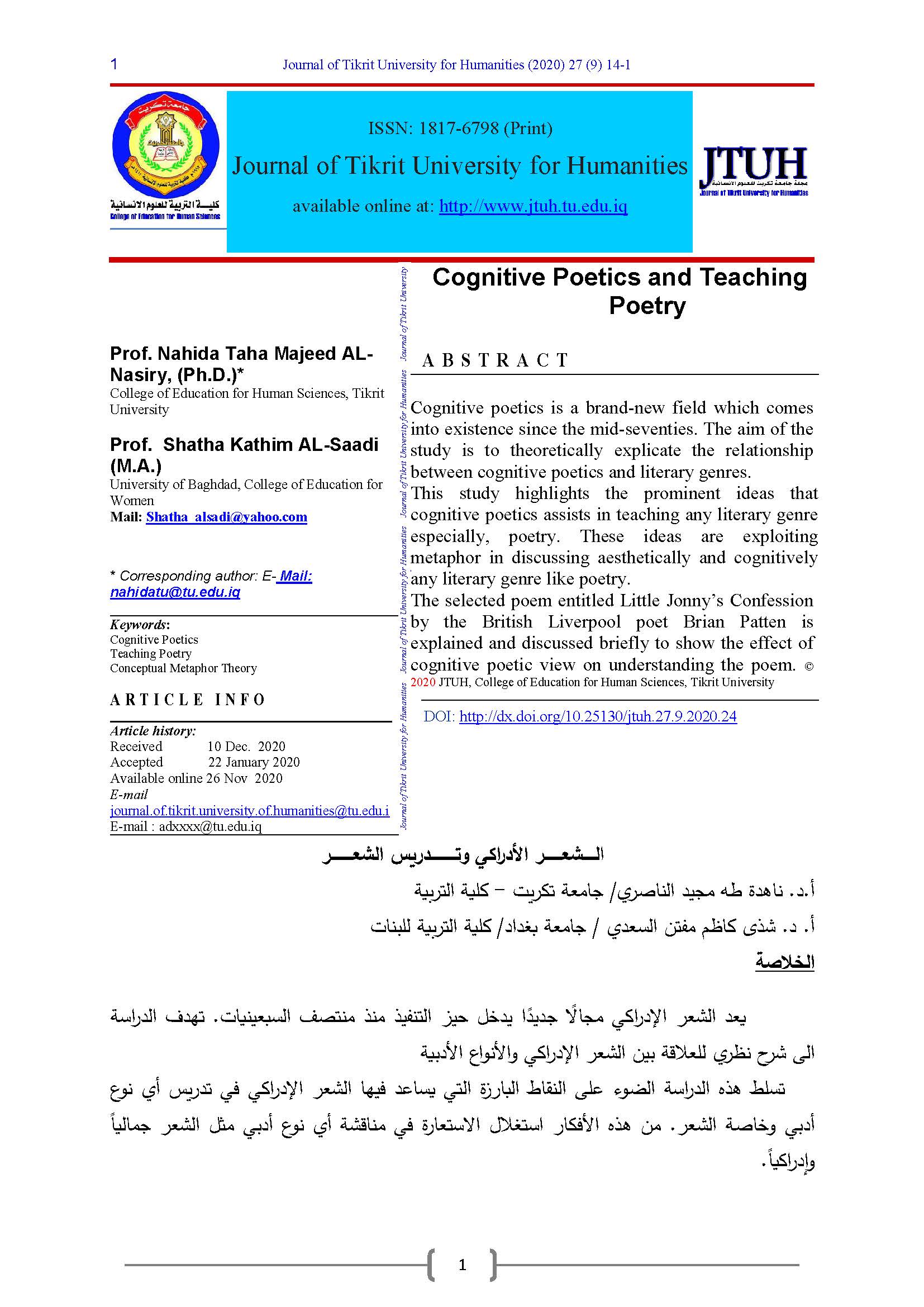
الملخص
يعد الشعر الإدراكي مجالًا جديدًا يدخل حيز التنفيذ منذ منتصف السبعينيات. تهدف الدراسة الى شرح نظري للعلاقة بين الشعر الإدراكي والأنواع الأدبية
تسلط هذه الدراسة الضوء على النقاط البارزة التي يساعد فيها الشعر الإدراكي في تدريس أي نوع أدبي وخاصة الشعر. من هذه الأفكار استغلال الاستعارة في مناقشة أي نوع أدبي مثل الشعر جمالياً وإدراكياً.
يتم شرح القصيدة المختارة التي تحمل عنوان اعتراف ليتل جوني من قبل الشاعر البريطاني براين باتن ومناقشتها بإيجاز لإظهار تأثير الرؤية الشعرية المعرفية على فهم القصيدة.
المقاييس
تفاصيل المقالة

هذا العمل مرخص بموجب Creative Commons Attribution 4.0 International License.




المراجع
AL-Saadi, Shatha (2012).Innocence, Love, and Experience in Some Selected Poems by Liverpool Poets: Adrian Henri, Roger McGough and Brian Patten. Higher Academy for Scientific and Humanistic Studies: Iraq.
Bruner, Jerome (2012) “Knowing is a process not a product”. In The Psychology Book Landu Scarlett O’Harra (ed.) .New York: DK Publishing 375. Freeman, Margaret. H. (2009). “The Fall of the Wall between literary studies and linguistics: Cognitive Poetics”. https://www.researchgate.net/publication/228300388.
Croft, Williams and Cruse, D. Alan (2014). Cognitive Linguistics. Cambridge: Cambridge University Press.
Dancygier, Barbra,I (2017). “Introduction”. In The Cambridge Handbook of Cognitive Linguistics. Edited by Barbra Dancygier. Cambridge: Cambridge University Press.
Freeman, Margaret (2002). “The body in the word: A Cognitive Approach to the Shape of a Poetic Text”. In Cognitive Stylistics: Language and Cognition in text analysis. (Eds.) Amsterdam: John Benjamins Publishing Company.
Freeman, Margaret H. (2009). “The Fall of the Wall between Literary Studies and Linguistics: Cognitive Poetics”.http:// www.reserachgate.net/publication//228300388.
Gardner,Howard (1987). “The Mind’s New Science: A history of the Cognitive Revolution”. In Philosophia. Vol.17, No. 2.Reviewed by Gary James Jason. Department of Philosophy, Washburn University.
Gavins and Steen, Gerard (2003) Cognitive Poetics in Practice. New York: Routledge.
Geeraerts, Dirk and Guyckens, Hurbert (2019) The Oxford Handbook of Cognitive Linguistics. Oxford: Oxford University Press, Inc.
Harrison, C and Stockwell, P. (2014) “Cognitive Poetics”. In J. Littlemore and J.R. Taylor (Eds.) The Bloomsbury Companion to Cognitive Linguistics. London: Bloomsbury. http://www.bloomsbury.com/uk/the-bloomsbury-companion-to-cognitive-linguistics-9781441195098 retrieved on 27-5-2019
Hollmann, Willern B. (2017) “Cognitive Linguistics.” In Dancygier, Barbra. The Cambridge Handbook of Cognitive Linguistics. Cambridge: Cambridge University Press.
Holme, Randal (2009) Cognitive Linguistics and Language Teaching. London: Palgrave Macmillan.https://www.simplypsychology.org/piaget.html
Kövecses, Zoltán ( 2017 ) Conceptual Metaphor Theory. In Roultage Handbook of Metaphor.Elena Semino and Zsófia Demjén.Roultedge: Roultage Handbook of Metaphor.
https://www.researchgate.net/publication/311403391_Conceptual_metaphor_theory
Lakoff,George and Johnson Mark(2003). Metaphors we Life by. Chicago: The University of Chicago.
Madesen, S. (1983). Techniques in Testing. New York: Oxford University Press, Inc.
Masuhara, Hitomi (2013). “Materials for Developing Reading Skills.” In Brian Tomlison (ed.) Developing Materials for Language Teaching. London: Bloomsbury Publishing Plc.
Pritchard, A. (2007) Effective Teaching with Internet Technologies: Pedagogy and Practice. Thousand Oaks, CA: Sage Publications.
Patten, Brian (2012).Poem Hunter.
http:// www.poem hunter.com. Patten’s poems 2012(accessed July, 2019)
Semino, Elena, and Jonathan, Culpeper. (2002) Cognitive Stylistics: Language and Cognition in Text Analysis. In Elena Semino and Jonathan Culpeper. Amsterdam: John Benjamins Publishing Company.
Stockwell, P. (2002) Cognitive Poetics: An Introduction. London: Routledge.
Summerfield, Derek (2002). Effects of War: Moral Knowledge, Revenge, Reconciliation, and Medicalised Concepts of “Recovery”. http://dx. Doi.org/ 10.1136/bmj.325.7372.1105. BMJ. Nov 9; 325(7372): 1105–1107.
Taylor, Shelley and Crocker,Taylor Jennifer (1981)Schematic Bases of Social Information Processes. Available on: http:/www.reserachgate.net/ publication/24744965 _Schematic_bases_of_ Social_information_processing(accessed Aug. 14 2019).
Taylor, John R. (2008). “Some Pedagogical Implications of Cognitive Linguistics”. In Sabine De Knop and Teun De Rycher. Cognitive Approaches to Pedagogical Grammar. Berlin: Walter de Gruytert Gmb. H. & Co.KG. D.
Tsur, Reuven(2008) .Toward a Theory of Cognitive Poetics. 2nd Edition. Brighton: Sussex Academic Press.
Tsur, Reuven (2002). “Aspects of Cognitive Poetics”. In Alina Semino and Jonathan Culpeper (Eds.).Cognitive Stylistics: Language and Cognition in Text Analysis .John Benjamins Publishing: Amsterdam.
Turner, Mark (1991) “Language is a virus.” Poetics Today Maryland.
Ungerer, Friedrich and Hans-Jorg Schmid (1996) .An Introduction to Cognitive Linguistics. England: Pearson Education Limited.
Ungerer, Friedrich and Hans- Jorg Schmid (2006).An Introduction to Cognitive Linguistics. New York: Pearson Education Limited.
Vygotsky, L.S. (125/1971). Psychology of Art. Cambridge, M.A. MIT Press.
Widdoson, H. G. (1984).Explorations in Applied Linguistics 2.Oxford: Oxford University Press.
Xiao, Ling (2017). “Research on Teaching Models of College English from the Perspective of Cognitive Poetics”. Changsha Medical University, Changsha, 410.Advances in Social Science, Education and Humanities Research, volume 119.