The Effect of Script Strategy on Iraqi EFL Preparatory School Students’ Productive Writing Skills
Article Sidebar
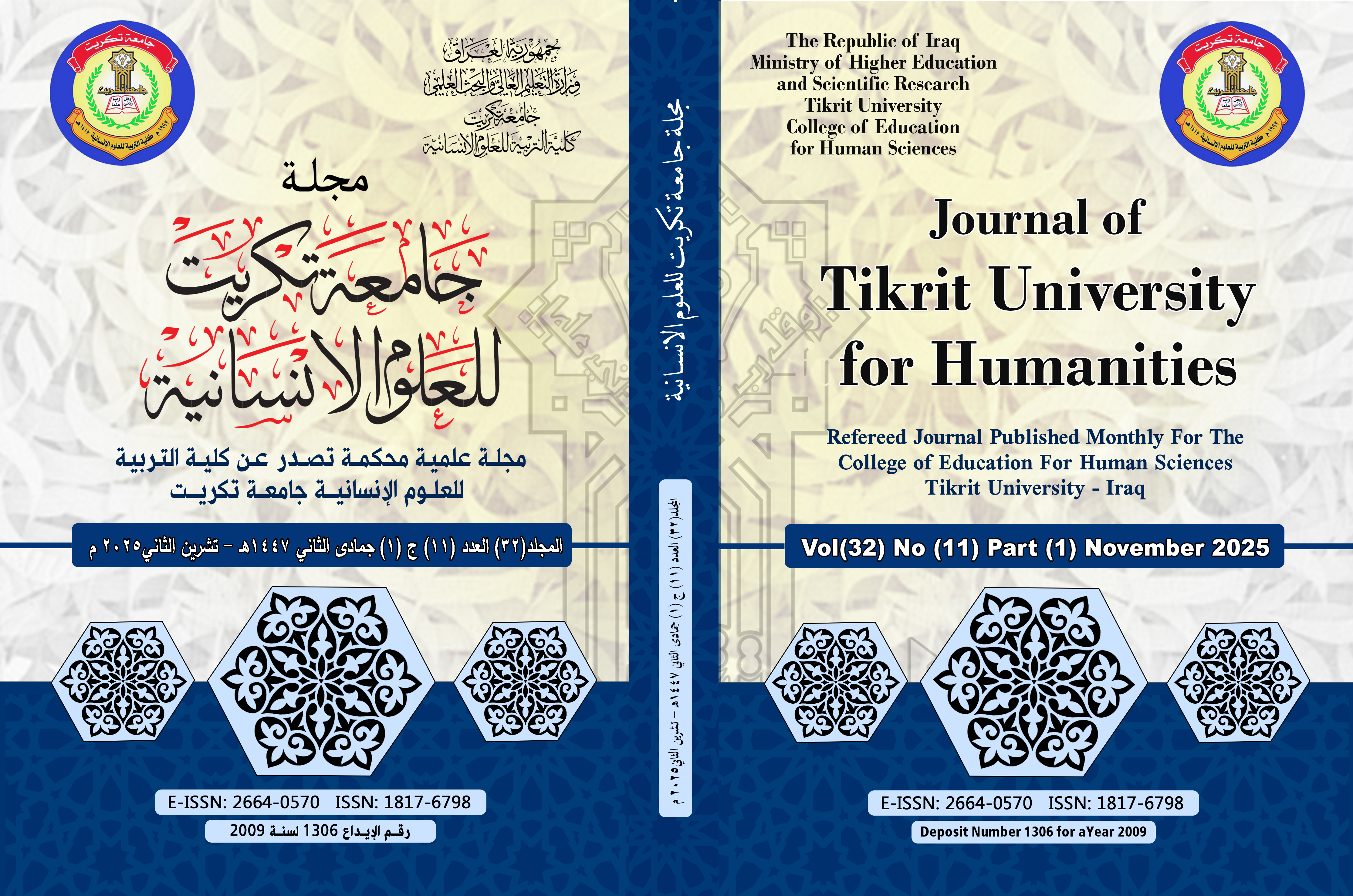
Main Article Content
Abstract
The present study aims to investigate the effectiveness of the Script Strategy in enhancing the productive writing skills of Iraqi EFL fifth-class preparatory school students. The research focuses on two primary objectives: determining the effect of the Script Strategy on students’ overall writing performance, and examining the strategy’s impact on specific writing components, including mechanics, content, language use, vocabulary, and organization. The study further evaluates whether the Script Strategy significantly contributes to the improvement of writing as a productive language skill among EFL learners. To address these objectives, the following hypothesis was tested: There is no statistically significant difference between the mean scores of the experimental group students, who are taught using the Script Strategy, and the control group students, who are taught using conventional methods, in their writing skills variables, including mechanics, content, language use, vocabulary, and organization, as measured in the post-test. A pilot test was initially conducted with a random sample of 20 students to establish baseline writing proficiency before the intervention. The main sample included 60 students from Uqba Bin Nafah Secondary School for Boys in Tikrit City, divided into an experimental and a control group. Data were analyzed using ANOVA, independent samples t-tests, and Cronbach’s alpha for reliability. Results indicated a statistically significant improvement in the writing performance of the experimental group. Qualitative feedback from students and teachers also suggested favorable perceptions of the Script Strategy as a teaching tool. These findings support the use of structured strategies in enhancing EFL learners’ writing skills.
Metrics
Article Details

This work is licensed under a Creative Commons Attribution 4.0 International License.




References
Al-Azzawii, Istabraq Tariq, (2023). "Note Taking in Teaching Literature". Tikrit University, Journal for Humanities Vol.30, No.12 December. Unversity of Tikrit.
Abbas, F. A. (2020). Difficulties in teaching and learning English writing in Iraqi secondary schools. Tikrit Journal for Humanities, 27(1), 55–68.Unversity of Tikrit;
Alfaki, I. M. (2015). University students’ English writing problems: Diagnosis and remedy. International Journal of English Language Teaching, 3(3), 40–52. https://doi.org/10.37745/ijelt.2015.v3n3p40
Al-Jubouri, M., & Sadiq, H. (2021). Enhancing Iraqi EFL learners’ writing skills through communicative teaching strategies. Journal of Language and Linguistic Studies, 17(2), 102–115. https://doi.org/xx.xxx/yyyy
Al-Samawi, M. A. (2000). Statistical methods for education and psychological research. Dar Al-Fikr for Publishing.
Ary, D., Jacobs, L. C., Sorensen, C. K., & Walker, D. (2010). Introduction to research in education (8th ed.). Wadsworth Cengage Learning.
Best, J. W., & Kahn, J. V. (2006). Research in education (10th ed.). Pearson Education.
Black, P., & Wiliam, D. (1998). Assessment and classroom learning. Assessment in Education: Principles, Policy & Practice, 5(1), 7–74. https://doi.org/10.1080/0969595980050102
Boehm, A. E. (2008). Test construction: Development and interpretation of achievement tests. In A. E. Boehm & B. L. Sabatine (Eds.), Educational and psychological measurement (pp. 142–158). Routledge.
Boehm, A. E. (2008). Test validity: Content and construct considerations. In T. B. Gutkin & C. R. Reynolds (Eds.), The handbook of school psychology (4th ed., pp. 66–88). John Wiley & Sons.
Brown, H. D. (2004). Language assessment: Principles and classroom practices. Pearson Education.
Brown, H. D. (2007). Principles of language learning and teaching (5th ed.). Pearson Education.
Harmer, J. (2004). How to teach writing. Pearson Education.
Brown, J. D. (2010). Testing in language programs: A comprehensive guide to English language assessment (2nd ed.). McGraw-Hill.
Chinn, C. A., O'Donnell, A. M., & Jinks, T. S. (1993). The structure of discourse in collaborative learning. Journal of Experimental Education, 61(3), 227–247. https://doi.org/10.1080/00220973.1993.9943835
Collins English Dictionary. (1987). Glasgow: HarperCollins Publishers.
Darling-Hammond, L. (2010). The flat world and education: How America's commitment to equity will determine our future. Teachers College Press.
Devellis, R. F. (2003). Scale development: Theory and applications (2nd ed.). Sage Publications.
Dillenbourg, P. (2002). Over-scripting CSCL: The risks of blending collaborative learning with instructional design. In P. A. Kirschner (Ed.), Three worlds of CSCL: Can we support CSCL? (pp. 61–91). Open Universiteit Nederland.
Drew, C. J. (2022). Understanding educational research: A practical guide. Sage Publications.
Ellis, R. (2015). Understanding second language acquisition (2nd ed.). Oxford University Press.
Field, J. (2005). Listening in the language classroom. Cambridge University Press.
Field, S. (2005). Screenplay: The foundations of screenwriting (3rd ed.). Delta Publishing.
Fletcher, J. D., Hawley, J. D., & Piele, P. K. (1993). Measuring educational outcomes: The validity and utility of educational assessments. In J. W. Guthrie (Ed.), Encyclopedia of education (2nd ed., Vol. 5, pp. 1234–1240). Macmillan.
Fraenkel, J. R., Wallen, N. E., & Hyun, H. H. (2012). How to design and evaluate research in education (8th ed.). McGraw-Hill Education.
Freiberg, H. J. (1999). School climate: Measuring, improving and sustaining healthy learning environments. Falmer Press.
Fullan, M. (2013). The new meaning of educational change (4th ed.). Teachers College Press.
Guskey, T. R. (2011). Visible learning: A synthesis of over 800 meta-analyses relating to achievement. Educational Horizons, 89(4), 246–249.
Haider, G. (2012). An insight into difficulties faced by Pakistani student writers: Implications for teaching of writing. Journal of Educational and Social Research, 2(3), 17–27. https://doi.org/10.36941/jesr-2012-0012
Harmer, J. (2004). How to teach writing. Pearson Education.
Harmer, J. (2007). The practice of English language teaching (4th ed.). Pearson Longman.
Harris, K. R., & Graham, S. (1996). Making the writing process work: Strategies for composition and self-regulation (2nd ed.). Brookline Books.
Harrison, C. (1983). Testing English: A handbook of writing tests. Longman.
Hattie, J. (2009). Visible learning: A synthesis of over 800 meta-analyses relating to achievement. Routledge.
Hughes, A. (1989). Testing for language teachers. Cambridge University Press.
Hyland, K. (2003). Second language writing. Cambridge University Press. https://doi.org/10.1017/CBO9780511667251
Indriani, L. (2017). The implementation of script strategy to improve students’ speaking skill. Journal of English Language Teaching and Linguistics, 2(2), 83–96. https://doi.org/10.21462/jeltl.v2i2.63
Ingersoll, R. M. (2003). Who controls teachers' work? Power and accountability in America's schools. Harvard University Press.
Israel, G. D. (2008). Determining sample size (Fact Sheet PEOD-6). University of Florida, Institute of Food and Agricultural Sciences. http://edis.ifas.ufl.edu/pd006
Jaramillo, L., & Medina, X. (2011). Promoting oral production through the task-based learning approach: A study in a public secondary school in Colombia. Profile Issues in Teachers' Professional Development, 13(1), 11–26.
Johnson, D. W., & Johnson, R. T. (2009). An educational psychology success story: Social interdependence theory and cooperative learning. Educational Researcher, 38(5), 365–379. https://doi.org/10.3102/0013189X09339057
Johnson, D. W., Johnson, R. T., & Holubec, E. J. (2017). Cooperation in the classroom (9th ed.). Interaction Book Company.
Lambiotte, J. G., Dansereau, D. F., O’Donnell, A. M., Johnson, D. L., & Mullins, D. (1988). Effects of script-based knowledge maps and cooperative scripts on the processing of technical material. Journal of Educational Psychology, 80(4), 448–456. https://doi.org/10.1037/0022-0663.80.4.448
Lewis, A., & Meed, J. (1986). Principles of test construction. Oxford University Press.
Marzano, R. J., Marzano, J. S., & Pickering, D. J. (2003). Classroom management that works: Research-based strategies for every teacher. ASCD.
Maslow, A. H. (1943). A theory of human motivation. Psychological Review, 50(4), 370–396. https://doi.org/10.1037/h0054346
McKee, R. (1997). Story: Substance, structure, style, and the principles of screenwriting. ReganBooks.
McNamara, T. F. (2000). Language testing. Oxford University Press.
Miller, S. M. (2008). Writing at the crossroads: Postmodern theory and the teaching of writing. National Council of Teachers of English.
Mousavi, S. A. (1992). An introduction to the testing of English as a second or foreign language. Teachers Library Press.
Note:
O’Donnell, A. M., Dansereau, D. F., & Hall, R. H. (1992). Knowledge maps as scaffolds for cognitive processing. Educational Psychology Review, 4(4), 293–319. https://doi.org/10.1007/BF01332176
Patrick, J. (1971). A dictionary of psychology. London: Routledge & Kegan Paul.
Popham, W. J. (2018). Classroom assessment: What teachers need to know (8th ed.). Pearson Education.
Raimes, A. (1983). Techniques in teaching writing. Oxford University Press.
Rao, P. S. (2017). The importance of writing skills in English language teaching: A study. Alford Council of International English & Literature Journal (ACIELJ), 2(2), 1–6.
Richards, J. C., & Renandya, W. A. (Eds.). (2002). Methodology in language teaching: An anthology of current practice. Cambridge University Press.
Rosas, M. (2000). Item analysis for test development. Journal of Educational Measurement, 37(1), 67–80.
Sarikas, D., Johnson, R., Patel, S., & Li, H. (2018). Exploring writing types in EFL classrooms. Journal of English Language Teaching and Linguistics, 6(1), 55–68.
Shaker, H. M. (2020). The effect of learner-centered approach on EFL students’ achievement and motivation. Tikrit University Journal for Humanities, 27(5), 112–128.
Shulman, L. S. (1987). Knowledge and teaching: Foundations of the new reform. Harvard Educational Review, 57(1), 1–22.
Slavin, R. E. (2020). Educational psychology: Theory and practice (12th ed.). Pearson.
Smith, L., & Johnson, R. (2020). Overcoming challenges in teaching English writing to EFL learners: A case study of Iraqi students. International Journal of Language Education, 6(4), 200–212.
Sugiyono. (2011). Metode penelitian kuantitatif, kualitatif dan R&D. Alfabeta.
Tomlinson, C. A. (2014). The differentiated classroom: Responding to the needs of all learners (2nd ed.). ASCD.
Truby, J. (2007). The anatomy of story: 22 steps to becoming a master storyteller. Faber & Faber.
Tuckman, B. W. (1972). Measuring educational outcomes: Fundamentals of testing. Harcourt Brace Jovanovich.
Weigle, S. C. (2002). Assessing writing. Cambridge University Press.
Wiggins, G., & McTighe, J. (2005). Understanding by design (Expanded 2nd ed.). ASCD.