تأثير نوعية المَهمة على استخدام الطلبة العراقيين الدارسين للغة الانكليزية كلغة اجنبية لاستراتيجيات التواصل
الشريط الجانبي للمقالة
محتوى المقالة الرئيسي
الملخص
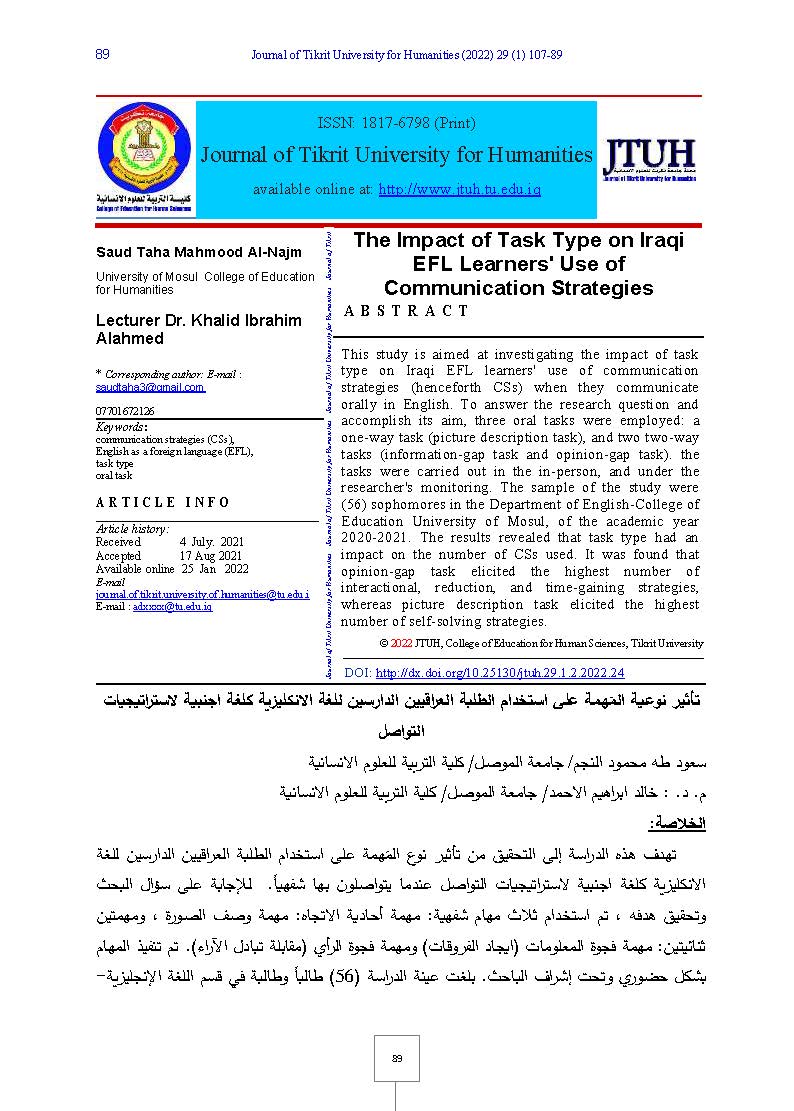
تهدف هذه الدراسة إلى التحقيق من تأثير نوع المَهمة على استخدام الطلبة العراقيين الدارسين للغة الانكليزية كلغة اجنبية لاستراتيجيات التواصل عندما يتواصلون بها شفهياً. للإجابة على سؤال البحث وتحقيق هدفه ، تم استخدام ثلاث مهام شفهية: مهمة أحادية الاتجاه: مهمة وصف الصورة ، ومهمتين ثنائيتين: مهمة فجوة المعلومات (ايجاد الفروقات) ومهمة فجوة الرأي (مقابلة تبادل الآراء). تم تنفيذ المهام بشكل حضوري وتحت إشراف الباحث. بلغت عينة الدراسة (56) طالباً وطالبة في قسم اللغة الإنجليزية- كلية التربية جامعة الموصل للعام الدراسي 2020-2021. كشفت النتائج أن نوع المهمة كان له تأثير على عدد المستخدمة. لقد وجد أن مهمة فجوة الرأي قد أثارت العدد الاكبر من استراتيجيات التفاعل ، والحد (التقليل) ، وكسب الوقت ، في حين أن مهمة وصف الصورة هي التي أثارت العدد الاكبر من استراتيجيات المعالجة الذاتية.
المقاييس
تفاصيل المقالة

هذا العمل مرخص بموجب Creative Commons Attribution 4.0 International License.




المراجع
Abunawas, S. N. (2012). Communication Strategies Used by Jordanian EFL Learners. Canadian Social Science, 8(4), 178-193.
Ahmed, S., & Pawar, S. V. (2018). A Study of Communication Strategies Employed by Radfan College EFL Students in Their Classroom Interactions. New Academia: An International Journal of English Language, Literature and Literary Theory, 8(3), 163-176.
Al Alawi, R. A. (2016). Communication Strategies Used by Omani EFL Students. Pyrex journal of English and literature, 2(1), 001-011.
Alahmed, K. I. (2017). Developing Strategic Competence through Task-Based Language Teaching: A Comparison of Implicit and Explicit Instruction. Unpublished doctoral dissertation.University of York.UK.
Bialystok, E. (1990). Communication strategies. Oxford: Blackwell.
Boxer, D. & Cohen, A. (2004) Studying Speaking to Inform Second Language Learning. Clevedon: multilingual matters LTd.
Brumfit, C. and K. Johnson (eds.). 1979. The Communicative Approach to Language Teaching (pp.1-37). Oxford: Oxford University Press.
Cook, V., & Cook, V. J. (1993). Linguistics and Second Language Acquisition (Vol. 12). London: Macmillan.
Corder, S. P. (1981). 1981: Error Analysis and Interlanguage. Oxford: Oxford University Press.
Dobao, A. M. F. (2001). Communication Strategies in the Interlanguage of Galician Students of English: The Influence of Learner-and Task-Related Factors. Atlantis, 41-62.
Dörnyei, Z. (1995). On the Teachability of Communication Strategies. TESOL quarterly, 29(1), 55-85.
Dörnyei, Z., & Scott, M. L. (1997). Communication Strategies in a Second Language: Definitions and Taxonomies. Language Learning, 47(1), 173-210.
Douglas, D. A. N., & Frazier, S. (2001). Teaching by Principles: An Interactive Approach to Language Pedagogy: H. Douglas Brown
Ellis, R. (1999). The Study of Second Language Acquisition. Oxford: Oxford University Press.
Ellis, R. (2003). Task-based language learning and teaching. Oxford: Oxford University Press.
Faerch, C., & Kasper, G. (1984). Two Ways of Defining Communication Strategies. Language learning, 34(1), 45-63.
Fallahi, S., Malayeri, F. A., & Bayat, A. (2015). The Effect of Information-Gap vs. Opinion-Gap Tasks on Iranian EFL Learners’ Reading Comprehension. International Journal of Education Investigations, 2(3), 170-181.
Ghout-Khenoune, L. (2012). The Effects of Task Type on Learners’ Use of Communication Strategies. Procedia-Social and Behavioral Sciences, 69, 770-779.
Haddad, Y. (2015). Investigating EFL Students' Communication Strategies in Overcoming Oral Vocabulary Gap: The Case of Masterii Didactics Students at Bejaia University ( MA thesis).University of Bejaia. Algeria.
Hardianti, R. (2016). A study of EFL Students’ Oral Communication Strategies in Discussions. Indonesian EFL Journal, 2(1), 23-33.
Heaton, J. B. (1988). Writing English Language Tests: Longman Group UK limited.
Larsen-Freeman, D., & Anderson, M. (2011). Techniques and Principles in Language Teaching 3rd Edition-Oxford Handbooks for Language Teachers. Oxford:Oxford university press.
Namaziandost, E., Neisi, L., Kheryadi, & Nasri, M. (2019). Enhancing Oral Proficiency through Cooperative Learning among Intermediate EFL Learners: English Learning Motivation in Focus. Cogent Education, 6(1), 1683933.
Oxford, R, L. (1990). Language Learning Strategies: What Every Teacher Should Know. New York: Newbury House
Pawlak, M. (2018). Investigating the Use of Speaking Strategies in the Performance of two Communicative Tasks: The Importance of Communicative Goal. Studies in Second Language Learning and Teaching, 8(2), 269-291.
Poulisse, N. (1987). Problems and Solutions in the Classification of Compensatory Strategies. Interlanguage studies bulletin (Utrecht), 3(2), 141-153.
Poulisse, N., Bongaerts, T., & Kellerman, E. (1984). On the Use of Compensatory Strategies in Second Language Performance. Interlanguage Studies Bulletin, 70-105.
Richards, J.C., & Schmidt, R, W. (1983). Language and Communication: Applied Linguistics and Language Study. New York: Oxford University Press.
Rosas, M. (2018). L2 learners’ Use of Communication Strategies as Affected by the Task Type. Revista Signos. Estudios de Lingüística, 51(96).
Tarone, E. (1976). Conscious Communication Strategies in Interlanguage: A Progress Report. TESOL, 77, 194-203.
Tarone, E. (1981). Some Thoughts on the Notion of Communication Strategy. TESOL quarterly, 15(3), 285-295.
Yule, G. & Tarone, E. (1990). Eliciting the performance of strategic competence. In R. Scarcella, E. Andersen & S. Krashen (Eds.), Developing Communicative Competence in a Second Language (pp. 179-194). Boston: Heinle & Heinle.
Zerrouki, N., & Al-Khanji, R. (2020). The Effect of Task Type on the Choice and Use of Communication Strategies by Algerian EFL Learners in Spoken Discourse.